Documentation forged from the code.
Paste or upload your ABAP, RAP, iFlow, or Fiori/UI5 application and get the technical document you'd hand to the client: every statement anchored to the artifact that backs it, in Word or Markdown. The source is processed and discarded — never stored.
3 documents a month, no card required.
Documenting doesn't get billed. It gets deducted.
Every hour you spend writing a TSD by hand is an hour you don't bill — and it's the part of the job you like least. Run the numbers yourself:
If your hour is worth more than $49, the first document of the month already paid for the plan. The rest of the month is margin.
Three steps. Nothing connects to your SAP system.
- 01
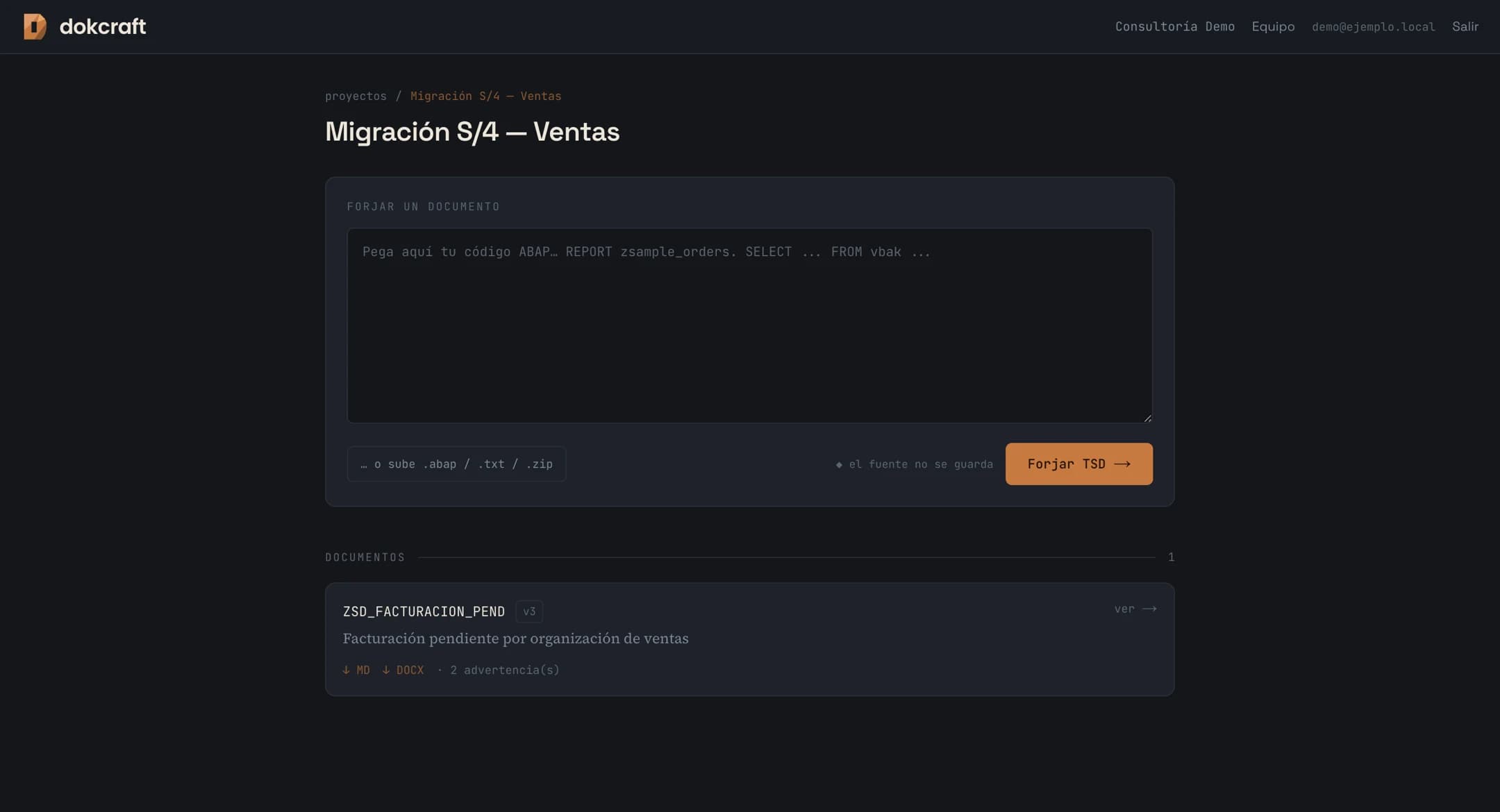
Paste or upload your SAP object
ABAP pasted or exported with abapGit, a RAP Business Object, an Integration Suite iFlow, or the ZIP of a Fiori/UI5 application.
Dokcraft detects the mode automatically. No need to connect it to your SAP system or rename artifacts.
- 02
It's analyzed with traceability
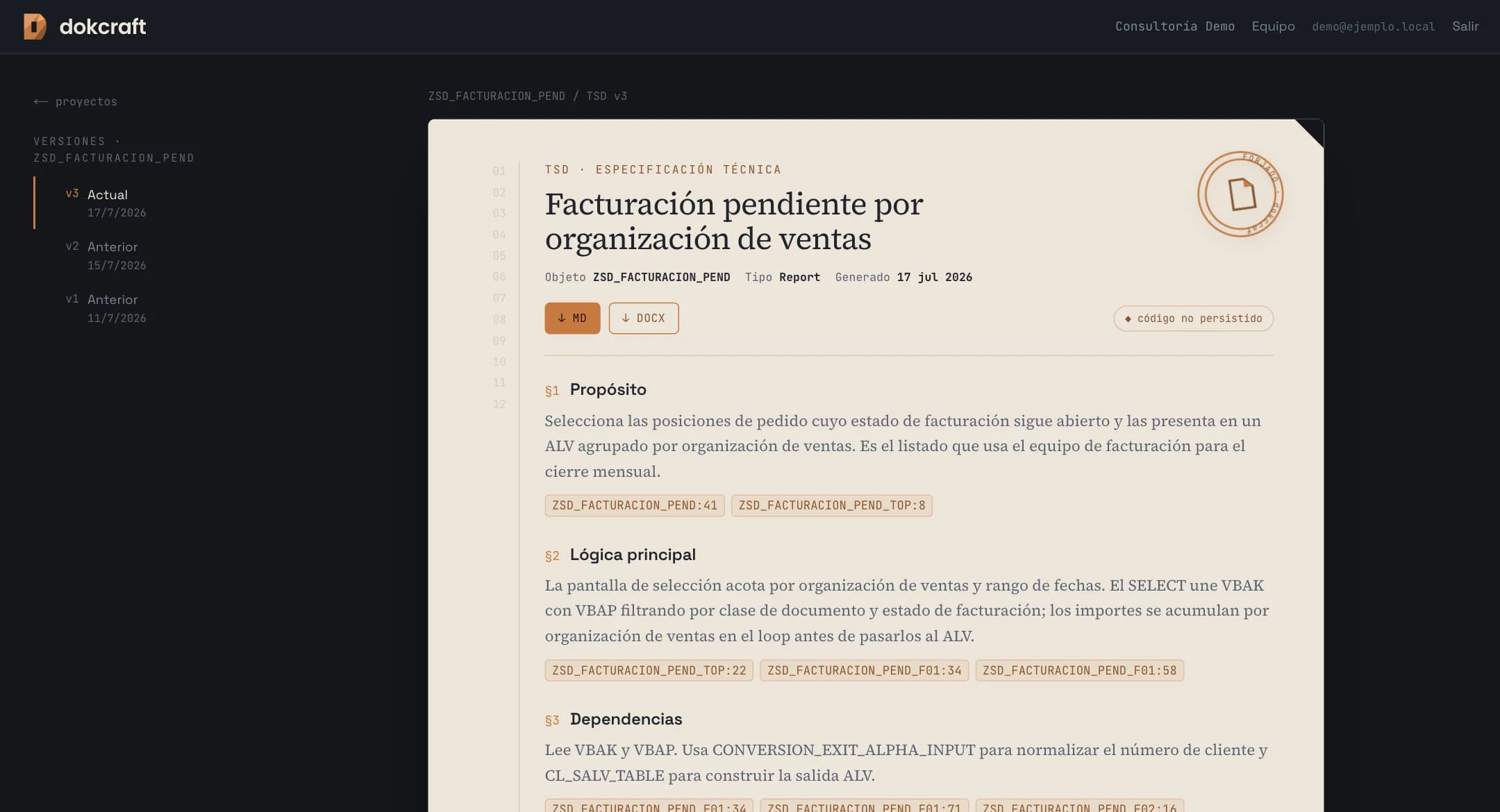
Every statement cites the line or artifact that backs it: ABAP includes, RAP layers, iFlow steps and resources, or the UI5 manifest, views, and controllers.
The source is processed in memory and discarded. It isn't saved or used to train models.
- 03
You download the deliverable
The client-ready TSD, in Word (DOCX) or Markdown. Every regeneration becomes a new version, with its own history.
Mass update of material descriptions
Purpose
Selects materials by MATNR ZBR_MAKT_UPDATE_S01:11, loads their descriptions from MARA and MAKT ZBR_MAKT_UPDATE_F01:21–30 and lets you edit MAKTX in an ALV ZBR_MAKT_UPDATE_F02:244–266.
Main logic
On save, it groups the descriptions by material ZBR_MAKT_UPDATE_F01:135–186, builds the BAPI structures, and calls BAPI_MATERIAL_SAVEREPLICA ZBR_MAKT_UPDATE_F01:190–201.
Architecture
The report is made up of 14 includes ZBR_MAKT_UPDATE:21–34: selection screen, event receivers, business logic, PBO, and PAI. The entry point hands off the flow to the FORM MAIN ZBR_MAKT_UPDATE:36–37.
Maintenance points
The BAPI operation hard-codes function='INS' ZBR_MAKT_UPDATE_F01:144–180; it's worth validating its semantics against existing materials. Only MAKTX stays editable ZBR_MAKT_UPDATE_F02:256–264 and newly pasted rows get removed ZBR_MAKT_UPDATE_F02:211–240.
Warnings
The package doesn't include DDIC text definitions or the full flow logic of Dynpros 0100/0101. The TSD flags that coverage as unverifiable instead of inventing it.
Public MIT source: ZBR_MAKT_UPDATE · Richard Bäck
This document came out of 1,081 lines of ABAP and 14 includes, without touching the system. Yours takes the same.
3 documents a month, no card.
Here's what it looks like inside.
You're uploading code that isn't yours. We know.
The source you're documenting usually belongs to your client, under NDA. That's the real objection, and the answer can't be a marketing promise:
Your client's code doesn't stay here
The source is processed in memory and discarded as soon as the document is generated. It isn't saved to the database, isn't used to train models, and doesn't end up in the document: what persists is line references in prose, not your code.
Every statement can be verified
Every point in the document cites the object and the line that backs it. You can check it against your source, line by line, before handing it to anyone. No invented prose that sounds good but isn't true.
It speaks the language of the deliverable
TSD, WRICEF, FSD. It's not a generic code summary: it's the document your client expects to receive, with the sections they expect to find.
Start free. Pay when it saves you hours.
Prices in US dollars (USD).
Free
- 3 documents / month
- 1 user
- Classic ABAP, DDIC included
- Full multi-include programs
- Documents carry a Dokcraft footer
Starter
- 15 documents / month
- 1 user
- Classic ABAP and full programs
- Word (DOCX) and Markdown
- Clean deliverable, unbranded
Pro
- 60 documents / month
- 3 users
- Everything in Starter
- RAP, iFlows, and Fiori/UI5 included
- Clean deliverable, unbranded
Scale
- 250 documents / month
- 10 users
- Everything in Pro
- RAP, iFlows, and Fiori/UI5 included
- Priority support
What people ask before uploading the first file.
Do you store my code?
No. The source is processed in memory and discarded as soon as the document is generated. It isn't saved to the database and isn't used to train models. What stays stored is the document: prose with line references, not your code.
How accurate is it?
Every statement in the document cites the object and the line that backs it, so you can verify it against your source point by point. It's a first-draft tool with traceability, not an oracle: the final review is still yours, but you start from a complete document instead of a blank page.
What objects does it support?
Classic ABAP — reports, function modules, classes, DDIC, and multi-include programs —, RAP Business Objects, SAP Integration Suite iFlows, and Fiori/UI5 V2, V4, or freestyle applications. Free covers classic ABAP; Starter includes one shared advanced generation a month; Pro and Scale include every mode.
Do I need abapGit?
No. It's the recommended path because the ZIP goes in directly without renaming anything, but you can paste a single object in the browser or upload the individual includes exported from SE38. Nothing connects to your SAP system.
How long does it take?
Between 10 and 130 seconds, depending on the size of the object. A large program with many includes takes longer than a single function module.
What formats do I get it in?
Word (DOCX) and Markdown. Every regeneration becomes a new version, and the history stays visible.
Can I cancel whenever I want?
Yes, no calls or emails. If you pay by card, from the billing portal. If you pay with PayPal, from your PayPal account: the cancellation is reflected here automatically and your plan reverts to free.
The next TSD you deliver — you don't have to write it.
3 documents a month, no card required.